
What insurance and licensing a commercial plumbing contractor should carry in South Carolina
By Diego Marsh · Updated 2026-07-12
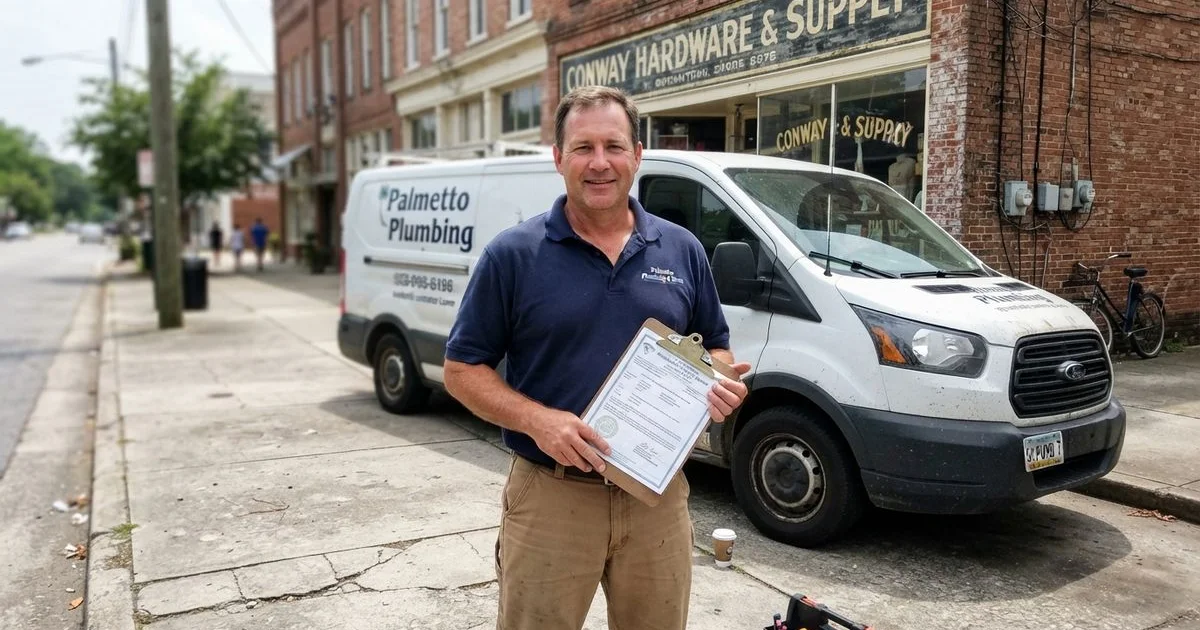
This is general information, not legal advice. Confirm license and insurance requirements directly with South Carolina’s Department of Labor, Licensing and Regulation or a licensed attorney for your specific situation.
Hiring a commercial plumbing contractor in Conway is a different exercise than calling someone for a home repair. A restaurant, office building, or apartment complex carries liability exposure a single-family home doesn’t, and the contractor’s licensing and insurance are what stand between a routine repair and a costly claim if something goes wrong on the job.
The licenses that actually apply
South Carolina splits plumbing licensing by scope of work:
- Residential Builders Commission (RBC): covers residential plumbing work over $500. This is the license most homeowner-facing plumbers carry.
- Contractor’s Licensing Board (CLB): covers general and mechanical contractors, which includes larger commercial plumbing work.
- Mechanical Contractors Licensing Board: an LLR-affiliated board that licenses HVAC, gas piping, plumbing, and electrical contractors separately from the general Contractor’s Licensing Board, with its own exam and classification system.
A contractor doing commercial work should be able to tell you specifically which license applies to your job and produce the license number without hesitation. If they’re vague about which board they’re licensed through, that’s worth pressing on before signing anything.
Verifying a license before you sign
South Carolina’s Department of Labor, Licensing and Regulation (LLR) is the umbrella agency overseeing these boards, and it maintains a public license lookup. Get the contractor’s license number directly, then verify it yourself rather than relying on a business card or website claim. This takes a few minutes and confirms the license is active, in good standing, and covers the type of work you’re hiring for.

Insurance: what to ask for
| Coverage type | What it protects against | Why it matters for commercial work |
|---|---|---|
| General liability insurance | Property damage or injury caused by the contractor’s work | Covers the building owner if a repair goes wrong |
| Workers’ compensation | Injury to the contractor’s own employees on your site | Protects you from liability if a worker is hurt on your property |
| Certificate of insurance (COI) | Proof of the above, naming your business if required | Many commercial leases and insurers require this before allowing work to start |
Ask for a certificate of insurance directly, not just a verbal assurance of coverage. Larger commercial properties, especially multi-tenant buildings, often have their own insurer requirements for what a contractor must carry before being allowed on site, so check with your property manager or insurance agent if you’re unsure what minimum applies to your building.
Why this matters more for commercial jobs
A residential repair gone wrong is contained to one household. A commercial plumbing failure, a backflow issue in a restaurant, a burst line above a retail space, a botched repair in a multi-tenant building, can affect other tenants, damage inventory, or trigger a code violation. That larger exposure is exactly why commercial-scale insurance and licensing checks matter more here than for a routine home repair, even when the actual plumbing work looks similar on paper.
Questions to ask before signing a commercial contract
- What license do you hold, and can you provide the number so I can verify it?
- Can you send a current certificate of insurance naming my business, if my lease or insurer requires it?
- Have you done work in my type of facility before (restaurant, office, multi-tenant residential)?
- Who pulls permits for code-driven work like backflow devices or gas piping, you or me? Our South Carolina plumbing permits guide covers how that process generally works.
Property managers: build this into your vendor process
If you manage a commercial building rather than own one outright, it’s worth setting a standing rule: no contractor works on site until their COI is on file, reviewed, and matches your building’s insurance minimums. Waiting to check this until a plumber is already on site, mid-emergency, is how gaps slip through. Keep a simple file of current COIs for your regular vendors, and set a reminder to request updated ones annually, since coverage can lapse or change without notice.
It’s also worth asking whether the coverage extends to subcontractors. A commercial plumbing company that brings in a subcontractor for specialty work, backflow testing or gas line certification, for example, should confirm that subcontractor carries their own adequate coverage too, not just ride on the primary contractor’s policy in a way that leaves a gap.
A contractor who answers these questions without pushback is generally the safer choice for commercial work, where the cost of getting it wrong is higher than it is at home. The commercial plumbing providers in Conway handle this kind of work regularly. For how we evaluate them, see our methodology, and visit the home page for other categories.
Common questions
- What license does a commercial plumber need in South Carolina?
- Commercial plumbing work generally requires licensing through South Carolina's Contractor's Licensing Board or the Mechanical Contractors Licensing Board, depending on the scope. Residential-only work has a separate licensing path through the Residential Builders Commission.
- How do I verify a contractor's license is real and active?
- South Carolina's Department of Labor, Licensing and Regulation (LLR) maintains a license lookup for contractors. Ask for the license number directly and check it before signing anything, rather than taking a business's word for it.
- What insurance should a commercial plumbing contractor carry?
- At minimum, general liability insurance and workers' compensation coverage if they have employees. For larger commercial jobs, ask about the coverage limits specifically, since a property manager's own insurer may require a minimum amount before allowing the contractor on site.
- Why does this matter more for commercial jobs than residential ones?
- Commercial properties carry more liability exposure, more people in the building, more expensive equipment and inventory at risk, and often stricter code requirements. A contractor without adequate coverage can leave the property owner exposed if something goes wrong.